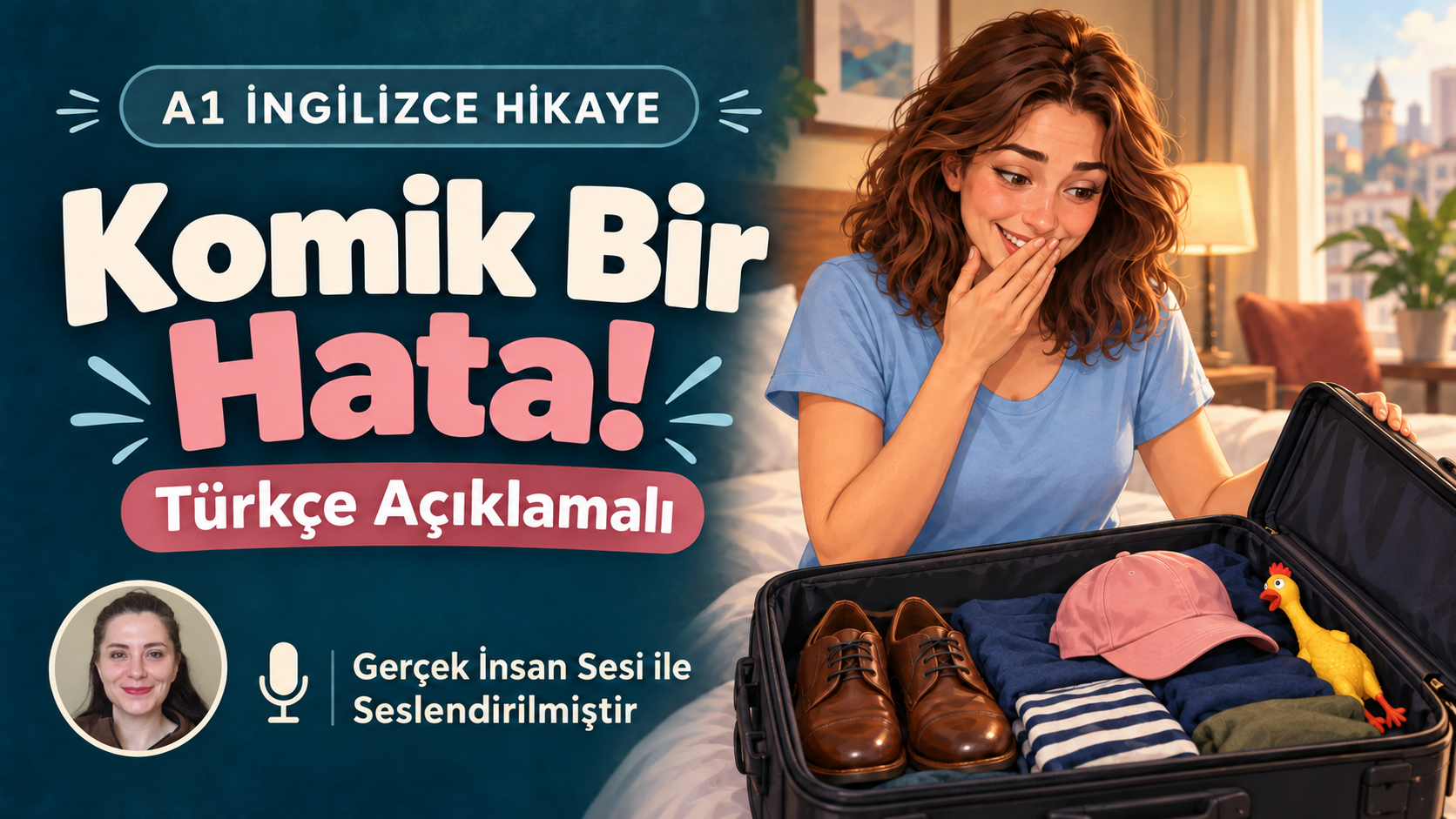
Bu A1 seviye İngilizce hikâyede Deniz’in tatilde yaşadığı komik bir valiz karışıklığını okuyacaksınız. Hikâyenin ardından tatil ve seyahat kelimelerini çalışabilir, Simple Past Tense (Geçmiş Zaman) alıştırmalarıyla öğrendiklerinizi pekiştirebilirsiniz.
📖 İngilizce Hikâye
A Funny Mistake!
My name is Deniz. Last Friday, I went to Antalya for a short holiday. I packed my clothes, my swimsuit, and my favorite book in a black suitcase.
After my flight, I got on a small hotel bus. There were six other people on the bus. I sat by the window and looked at the sea.
We arrived at the hotel at three o’clock. I took a black suitcase from the bus and went to my room.
I wanted to change my clothes and go to the beach. But when I opened the suitcase, I stopped. Inside, there were two very big shoes, a pink hat, and a yellow toy chicken.
I looked at the shoes.
“These aren’t mine!”
Then I picked up the chicken. It made a loud noise. I almost dropped it.
There were no swimsuits or books in the suitcase. Under the hat, I found a small card. There was a name on it.
“Oh, no. I took the wrong suitcase!”
I closed it and called reception.
“Hello. My name is Deniz. I’m in room 204. I have another person’s suitcase.”
“Is it black?” the receptionist asked.
“Yes, it is.”
“Please bring it downstairs. A man is here with your suitcase.”
I went downstairs quickly. A tall man stood next to reception. My suitcase was beside him.
“I’m very sorry,” I said. “Did you open my suitcase?”
“Yes,” he said. “I found a swimsuit and a book. But I didn’t find my chicken.”
We both laughed.
“Why do you have a toy chicken?” I asked.
“I work here,” he explained. “I play games with the children and make them laugh. The chicken helps me.”
We checked the names and took our own suitcases.
The next morning, I saw him near the pool. He wore his pink hat and big shoes. Some children laughed and waved at him.
Then I heard that chicken again. This time, I didn’t jump. I smiled and waved, too.
🇹🇷 Türkçe Çevirisi
Komik Bir Hata!
Benim adım Deniz. Geçen cuma kısa bir tatil için Antalya’ya gittim. Kıyafetlerimi, mayomu ve en sevdiğim kitabı siyah bir valize koydum.
Uçuşumdan sonra küçük bir otel otobüsüne bindim. Otobüste altı kişi daha vardı. Cam kenarına oturdum ve denize baktım.
Saat üçte otele vardık. Otobüsten siyah bir valiz aldım ve odama gittim.
Kıyafetlerimi değiştirip plaja gitmek istedim. Ama valizi açınca durdum. İçinde çok büyük iki ayakkabı, pembe bir şapka ve sarı bir oyuncak tavuk vardı.
Ayakkabılara baktım.
“Bunlar benim değil!”
Sonra tavuğu elime aldım. Yüksek bir ses çıkardı. Neredeyse onu düşürüyordum.
Valizde mayo ya da kitap yoktu. Şapkanın altında küçük bir kart buldum. Üzerinde bir isim vardı.
“Eyvah. Yanlış valizi aldım!”
Valizi kapattım ve resepsiyonu aradım.
“Merhaba. Benim adım Deniz. 204 numaralı odadayım. Başka birinin valizi bende.”
“Siyah mı?” diye sordu resepsiyon görevlisi.
“Evet, siyah.”
“Lütfen onu aşağıya getirin. Burada bir adam var. Sizin valiziniz onda.”
Hızlıca aşağıya indim. Resepsiyonun yanında uzun boylu bir adam duruyordu. Valizim onun yanındaydı.
“Çok özür dilerim,” dedim. “Valizimi açtınız mı?”
“Evet,” dedi. “Bir mayo ve bir kitap buldum. Ama tavuğumu bulamadım.”
İkimiz de güldük.
“Neden oyuncak bir tavuğunuz var?” diye sordum.
“Ben burada çalışıyorum,” diye açıkladı. “Çocuklarla oyunlar oynuyorum ve onları güldürüyorum. Tavuk bana yardım ediyor.”
İsimleri kontrol ettik ve kendi valizlerimizi aldık.
Ertesi sabah onu havuzun yakınında gördüm. Pembe şapkasını ve büyük ayakkabılarını giymişti. Birkaç çocuk güldü ve ona el salladı.
Sonra o tavuğun sesini tekrar duydum. Bu sefer irkilmedim. Ben de gülümsedim ve el salladım.
📚 Önemli Kelimeler ve İfadeler
İngilizce
Türkçe
suitcase
valiz
holiday
tatil
flight
uçuş
swimsuit
mayo
clothes
kıyafetler
beach
plaj
toy chicken
oyuncak tavuk
hat
şapka
reception
resepsiyon
receptionist
resepsiyon görevlisi
downstairs
aşağıya, alt kata
pool
havuz
wrong
yanlış
loud noise
yüksek ses
by the window
cam kenarında
next to / beside
yanında
pick up
eline almak, yerden almak
change my clothes
kıyafetlerimi değiştirmek
make them laugh
onları güldürmek
our own suitcases
kendi valizlerimiz
🔄 Hikâyedeki Düzensiz Fiiller
Fiilin yalın hâli
Geçmiş zaman hâli
Türkçe anlamı
go
went
gitmek
get on
got on
binmek
sit
sat
oturmak
take
took
almak
make
made
yapmak; ses çıkarmak
find
found
bulmak
stand
stood
ayakta durmak
say
said
söylemek
see
saw
görmek
wear
wore
giymek, takmak
hear
heard
duymak
💡 Kısa Gramer Notu: Simple Past Tense
Geçmişte gerçekleşip bitmiş olayları anlatırken Simple Past Tense kullanırız.
Olumlu cümlelerde düzenli fiillere -ed eklenir. Düzensiz fiillerin ise geçmiş zaman biçimleri kullanılır.
I opened the suitcase. → Valizi açtım.
I found a small card. → Küçük bir kart buldum.
Soru ve olumsuz cümlelerde did / didn’t kullanılır ve asıl fiil yalın hâline döner.
Did you open my suitcase? → Valizimi açtınız mı?
I didn’t find my chicken. → Tavuğumu bulamadım.
✅ I didn’t find my chicken. ❌ I didn’t found my chicken.
“There were” ise geçmişte bir yerde birden fazla kişinin veya nesnenin bulunduğunu belirtir.
There were six other people on the bus. → Otobüste altı kişi daha vardı.
There was a name on it. → Üzerinde bir isim vardı.
✏️ Alıştırma 1: Hikâyeyi Anlama
Soruları İngilizce kısa cevaplarla yanıtlayın.
Where did Deniz go for her holiday?
What color was the suitcase?
What did Deniz find under the hat?
Did the man find his chicken in Deniz’s suitcase?
Where did Deniz see the man the next morning?
✏️ Alıştırma 2: Kelimelerle Boşluk Doldurma
Her kelimeyi bir kez kullanın.
Kelimeler: suitcase – flight – downstairs – pool – hat
After my __________, I got on a small hotel bus.
I packed my clothes in a black __________.
Under the __________, I found a small card.
Please bring it __________.
The next morning, I saw him near the __________.
✏️ Alıştırma 3: Fiillerin Geçmiş Zaman Hâli
Parantez içindeki fiilleri Simple Past Tense ile tamamlayın.
Last Friday, Deniz __________ to Antalya. (go)
She __________ the suitcase in her room. (open)
She __________ a small card under the hat. (find)
Deniz and the man both __________. (laugh)
The man __________ his pink hat the next morning. (wear)
Deniz __________ the toy chicken again. (hear)
✏️ Alıştırma 4: Hataları Düzeltme
Aşağıdaki cümlelerde geçmiş zaman kullanımına ilişkin birer hata var. Cümleleri doğru şekilde yeniden yazın.
Did you opened my suitcase?
I didn’t found my chicken.
Deniz go to Antalya last Friday.
There was six other people on the bus.
She didn’t jumped this time.
✅ Cevap Anahtarı
Alıştırma 1
She went to Antalya.
It was black.
She found a small card.
No, he didn’t.
She saw him near the pool.
Alıştırma 2
flight
suitcase
hat
downstairs
pool
Alıştırma 3
went
opened
found
laughed
wore
heard
Alıştırma 4
Did you open my suitcase?
I didn’t find my chicken.
Deniz went to Antalya last Friday.
There were six other people on the bus.
She didn’t jump this time.
🎧 Dinleyerek Pratik Yapın
Bu hikâyenin seslendirmesini Kolay İngilizce Hikayeler YouTube kanalında dinleyebilirsiniz. Önce İngilizce dinleyin, ardından Türkçe açıklamalarla kelimeleri ve cümleleri inceleyin. Son olarak altyazısız dinleyerek anlama becerinizi deneyin.
💬 Sıra sizde: “I went…” ile başlayan, geçmişte yaptığınız bir yolculuğu anlatan İngilizce bir cümle yazın!
My name is Murat, and I am nineteen years old. I want to become a pilot one day.
When I was a child, I was very interested in airplanes. I often watched them in the sky and tried to guess where they were going. At primary school, my teacher once asked our class, “What do you want to be when you grow up?” Some students wanted to be doctors or teachers. I said, “I want to be a pilot.”
My classmates smiled, but I was serious. That day, I drew a picture of an airplane in my notebook. I still remember it.
As I grew older, I started to learn more about aviation. I discovered that becoming a pilot takes a lot of time and effort. Pilots need to study subjects such as weather, navigation, safety, and aircraft systems. English is also very important because pilots use it to communicate with air traffic controllers and other pilots.
Last year, I visited a flight school with my uncle. An instructor showed us the classrooms and the training airplanes. He explained that students have theory lessons first. They also need to pass a medical examination before they can begin flight training.
A few months later, I started taking aviation lessons. At first, some subjects were difficult, especially navigation and weather. I took notes, watched videos, and asked my teachers many questions.
Then I had my first flight lesson.
Before takeoff, my instructor and I checked the airplane together. He showed me the controls and explained what each one did. I was nervous, but I was also very excited.
When the airplane left the ground, I looked out of the window. The houses, roads, and fields looked very small below us.
It was an unforgettable moment.
I know I still have a long way to go. I need to improve my English, pass my exams, and complete many hours of flight training.
But I am ready to work hard.
One day, I hope to enter the cockpit as a real pilot and say, “Welcome aboard.”
🇹🇷 Pilot Olmak İstiyorum
Benim adım Murat ve on dokuz yaşındayım. Bir gün pilot olmak istiyorum.
Çocukken uçaklara çok ilgi duyuyordum. Onları sık sık gökyüzünde izler ve nereye gittiklerini tahmin etmeye çalışırdım. İlkokuldayken öğretmenim bir gün sınıfa, “Büyüyünce ne olmak istiyorsunuz?” diye sordu. Bazı öğrenciler doktor veya öğretmen olmak istiyordu. Ben ise, “Pilot olmak istiyorum,” dedim.
Sınıf arkadaşlarım gülümsedi ama ben ciddiydim. O gün defterime bir uçak resmi çizdim. Bunu hâlâ hatırlıyorum.
Büyüdükçe havacılık hakkında daha fazla şey öğrenmeye başladım. Pilot olmanın çok fazla zaman ve emek gerektirdiğini öğrendim. Pilotların hava durumu, navigasyon, güvenlik ve uçak sistemleri gibi konuları çalışması gerekir. İngilizce de çok önemlidir çünkü pilotlar hava trafik kontrolörleri ve diğer pilotlarla iletişim kurmak için İngilizce kullanır.
Geçen yıl amcamla birlikte bir uçuş okulunu ziyaret ettim. Bir eğitmen bize sınıfları ve eğitim uçaklarını gösterdi. Öğrencilerin önce teorik dersler aldığını açıkladı. Ayrıca uçuş eğitimine başlamadan önce sağlık muayenesinden geçmeleri gerektiğini söyledi.
Birkaç ay sonra havacılık dersleri almaya başladım. Başta bazı konular zordu, özellikle navigasyon ve hava durumu. Not aldım, videolar izledim ve öğretmenlerime birçok soru sordum.
Sonra ilk uçuş dersimi yaptım.
Kalkıştan önce eğitmenimle birlikte uçağı kontrol ettik. Bana kontrolleri gösterdi ve her birinin ne işe yaradığını açıkladı. Gergindim ama aynı zamanda çok heyecanlıydım.
Uçak yerden ayrıldığında pencereden dışarı baktım. Aşağımızdaki evler, yollar ve tarlalar çok küçük görünüyordu.
Bu unutulmaz bir andı.
Hâlâ önümde uzun bir yol olduğunu biliyorum. İngilizcemi geliştirmem, sınavlarımı geçmem ve birçok saatlik uçuş eğitimini tamamlamam gerekiyor.
Ama çok çalışmaya hazırım.
Bir gün gerçek bir pilot olarak kokpite girmeyi ve “Uçağımıza hoş geldiniz,” demeyi umuyorum.
📚 Önemli Kelimeler
English
Türkçe
pilot
pilot
airplane
uçak
aviation
havacılık
cockpit
kokpit
flight school
uçuş okulu
instructor
eğitmen
flight training
uçuş eğitimi
theory lesson
teorik ders
weather
hava durumu
navigation
navigasyon / yön bulma
safety
güvenlik
aircraft system
uçak sistemi
air traffic controller
hava trafik kontrolörü
medical examination
sağlık muayenesi
takeoff
kalkış
control
kontrol / kumanda
exam
sınav
flight lesson
uçuş dersi
field
tarla
effort
emek / çaba
unforgettable
unutulmaz
nervous
gergin
excited
heyecanlı
🔹 Önemli Fiiller
Verb
Türkçe
Past Form
want
istemek
wanted
watch
izlemek
watched
guess
tahmin etmek
guessed
ask
sormak
asked
draw
çizmek
drew
remember
hatırlamak
remembered
learn
öğrenmek
learned
discover
keşfetmek / öğrenmek
discovered
study
çalışmak
studied
communicate
iletişim kurmak
communicated
visit
ziyaret etmek
visited
show
göstermek
showed
explain
açıklamak
explained
begin
başlamak
began
take notes
not almak
took notes
check
kontrol etmek
checked
improve
geliştirmek
improved
pass
geçmek
passed
complete
tamamlamak
completed
hope
ummak
hoped
✍️ Alıştırma 1 – Doğru mu, Yanlış mı?
Cümlelerin doğruysa True, yanlışsa False yazın.
Murat is nineteen years old.
Murat wanted to become a doctor when he was a child.
Murat visited a flight school with his uncle.
Pilots do not need English.
Murat found navigation and weather difficult at first.
Murat has already completed all his flight training.
✍️ Alıştırma 2 – Çoktan Seçmeli Sorular
1. What did Murat want to be when he was a child?
A) A doctor B) A teacher C) A pilot
2. Who did Murat visit the flight school with?
A) His father B) His uncle C) His teacher
3. What do students need before flight training?
A) A medical examination B) A new passport C) A car
4. Which subjects were difficult for Murat?
A) History and maths B) Navigation and weather C) English and art
5. How did Murat feel before his first flight?
A) Bored and tired B) Angry and worried C) Nervous and excited
✍️ Alıştırma 3 – Boşlukları Doldurun
Aşağıdaki kelimeleri kullanarak boşlukları doldurun.
pilot – flight school – weather – instructor – exams – cockpit
Murat wants to become a __________.
Last year, he visited a __________.
His __________ showed him the training airplanes.
Pilots need to understand __________ conditions.
Murat needs to pass his __________.
One day, he hopes to enter the __________ as a real pilot.
✍️ Alıştırma 4 – Fiilleri Geçmiş Zamana Çevirin
Parantez içindeki fiilleri Past Simple hâline getirin.
Murat __________ airplanes in the sky. (watch)
His teacher __________ the class a question. (ask)
Murat __________ a picture of an airplane. (draw)
He __________ a flight school last year. (visit)
The instructor __________ the controls. (explain)
Murat __________ many questions. (ask)
They __________ the airplane before takeoff. (check)
✍️ Alıştırma 5 – Soruları Cevaplayın
Soruları İngilizce olarak kısa cümlelerle cevaplamaya çalışın.
How old is Murat?
What was Murat interested in when he was a child?
Why is English important for pilots?
What did Murat do at the flight school?
How did he feel before his first flight?
What does Murat still need to do before becoming a pilot?
Apologizing and Giving Explanations, 8. sınıf İngilizce Ünite 1: Friendship kapsamında yer alan ikinci konudur.
Bu konuda özür dilemeyi, bir davete neden katılamadığımızı açıklamayı ve because, have to, must, can’t gibi yapılarla neden belirtmeyi öğreneceğiz.
MEB 8. sınıf Friendship ünitesinde öğrencilerden kısa konuşmalarda özür ifadelerini anlayabilmeleri, açıklama ve neden verebilmeleri ve bir davete katılamadıkları durumlarda kısa bir özür mesajı veya mektubu yazabilmeleri beklenmektedir.
Not: Bu konu anlatımı, örnekler ve etkinlikler Semay English tarafından özgün olarak hazırlanmıştır. Ders kitabındaki metin veya etkinliklerin kopyası değildir.
Apologizing Ne Demek?
apologize → özür dilemek apology → özür
Bir hata yaptığımızda, bir planı iptal ettiğimizde veya bir davete katılamadığımızda özür dilemek için çeşitli ifadeler kullanabiliriz.
Temel Özür İfadeleri
İngilizce
Türkçe
Sorry.
Üzgünüm / Özür dilerim.
I’m sorry.
Üzgünüm.
I’m really sorry.
Gerçekten üzgünüm.
I’m so sorry.
Çok üzgünüm.
I’m sorry, but…
Üzgünüm ama…
I’m afraid I can’t.
Ne yazık ki yapamam / gelemem.
I apologize.
Özür dilerim.
🙁 I’m Sorry, But…
Bir daveti reddederken veya bir şeyi yapamadığımızı açıklarken en kullanışlı kalıplardan biri:
I’m sorry, but + cümle
Örnekler
I’m sorry, but I can’t come to the party. Üzgünüm ama partiye gelemem.
I’m sorry, but I’m busy tonight. Üzgünüm ama bu akşam meşgulüm.
I’m sorry, but I have another plan. Üzgünüm ama başka bir planım var.
MEB programındaki örneklerde de daveti reddetme ve neden belirtme birlikte kullanılır. Örneğin kişinin başka bir planı olduğu için davete katılamadığını açıklaması beklenir.
💬 I’d Love To, But…
Bir davete aslında katılmak istediğimizi ancak katılamadığımızı söylemek için:
I’d love to, but…
kullanabiliriz.
I’d love to = I would love to
Örnekler
I’d love to, but I can’t. Çok isterdim ama gelemem.
I’d love to, but I have an exam tomorrow. Çok isterdim ama yarın sınavım var.
I’d love to come, but I’m visiting my grandparents. Gelmeyi çok isterdim ama büyükanne ve büyükbabamı ziyaret edeceğim.
Bu yapı hem kibar bir ret hem de açıklama için çok kullanışlıdır.
❓ Giving Explanations – Açıklama ve Neden Belirtme
explanation → açıklama reason → neden / sebep
Bir şeyi neden yapamadığımızı anlatırken farklı ifadeler kullanabiliriz.
Örnek Nedenler
I have an exam. Sınavım var.
I have to study. Ders çalışmak zorundayım.
I’m busy. Meşgulüm.
I’m ill. Hastayım.
I’m visiting my grandparents. Büyükanne ve büyükbabamı ziyaret ediyorum.
My cousin is coming to visit us. Kuzenim bizi ziyarete geliyor.
I have football training. Futbol antrenmanım var.
I have another plan. Başka bir planım var.
🔗 Because – Çünkü
Bir olayın nedenini açıklarken because kullanabiliriz.
Yapı
Sonuç + because + neden
Örnekler
I can’t come because I have an exam. Gelemiyorum çünkü sınavım var.
I can’t join you because I’m busy. Size katılamıyorum çünkü meşgulüm.
She can’t come because she is ill. O gelemiyor çünkü hasta.
Mert can’t attend the party because he has football training. Mert partiye katılamıyor çünkü futbol antrenmanı var.
Because ile İki Cümleyi Birleştirme
I can’t come. I have to study.
Bu iki cümleyi birleştirebiliriz:
I can’t come because I have to study.
Ece can’t join us. She is visiting her grandmother.
→ Ece can’t join us because she is visiting her grandmother.
📌 Have To – Zorunda Olmak
Bir şeyi yapmamız gerektiği için bir davete katılamıyorsak have to kullanabiliriz.
I / You / We / They
have to + fiil
I have to study. Ders çalışmak zorundayım.
We have to finish our project. Projemizi bitirmek zorundayız.
He / She
has to + fiil
She has to study. Ders çalışmak zorunda.
Mert has to visit his grandparents. Mert büyükanne ve büyükbabasını ziyaret etmek zorunda.
Must ile Neden Belirtme
must da güçlü bir gereklilik ifade edebilir.
I must finish my homework. Ödevimi bitirmeliyim.
I can’t come because I must study for my exam. Gelemiyorum çünkü sınavıma çalışmalıyım.
Dikkat
must sonrasında fiilin yalın hâli kullanılır:
✅ I must study.
❌ I must to study.
🚫 Can’t Make It Ne Demek?
I can’t make it, günlük İngilizcede:
“Gelemeyeceğim / Katılamayacağım.”
anlamında çok kullanılan bir ifadedir.
Örnekler
Sorry, I can’t make it. Üzgünüm, gelemeyeceğim.
I’d love to come, but I can’t make it on Saturday. Gelmeyi çok isterdim ama cumartesi katılamayacağım.
MEB’in Friendship materyallerindeki davet sorularında da “I can’t make it” gibi ret ifadeleri kullanılır.
🙏 Thanks for the Invitation
Bir daveti reddederken önce teşekkür etmek daha kibar bir cevap oluşturur.
Thanks for the invitation. Davet için teşekkürler.
Thanks for inviting me. Beni davet ettiğin için teşekkürler.
That’s very kind of you. Bu çok nazikçe.
Örnek
Thanks for the invitation. I’d love to come, but I can’t make it.
Davet için teşekkürler. Gelmeyi çok isterdim ama katılamayacağım.
📝 Kibar Bir Ret Cevabı Nasıl Oluşturulur?
İyi bir ret cevabını üç bölüm hâlinde düşünebiliriz:
1. Teşekkür Et
Thanks for the invitation.
2. Özür Dile / Reddet
I’m sorry, but I can’t come.
3. Neden Belirt
I have to study for my exam.
Tam Cümle
Thanks for the invitation. I’m sorry, but I can’t come because I have to study for my exam.
Davet için teşekkürler. Üzgünüm ama gelemem çünkü sınavıma çalışmam gerekiyor.
💡 Başka Bir Zaman Önerme
Bir daveti reddettikten sonra başka bir zaman önerebiliriz.
Maybe another time. Belki başka zaman.
Maybe next weekend. Belki gelecek hafta sonu.
How about next Saturday? Gelecek cumartesiye ne dersin?
Let’s meet another day. Başka bir gün buluşalım.
Örnek
I’m sorry, but I can’t meet you tonight. How about Saturday? Üzgünüm ama bu akşam buluşamam. Cumartesiye ne dersin?
✅ Apology + Reason Örnekleri
Örnek 1
I’m sorry, but I can’t come because I’m ill. Üzgünüm ama gelemem çünkü hastayım.
Örnek 2
I’d love to join you, but I have to study. Size katılmayı çok isterdim ama ders çalışmam gerekiyor.
Örnek 3
Thanks for inviting me, but I have another plan. Beni davet ettiğin için teşekkürler ama başka bir planım var.
Örnek 4
I’m afraid I can’t make it because my cousin is visiting us. Ne yazık ki katılamayacağım çünkü kuzenim bizi ziyaret ediyor.
Örnek 5
I’m really sorry. I must help my parents today. Gerçekten üzgünüm. Bugün aileme yardım etmeliyim.
💬 Mini Diyalog: A Birthday Party
Ece: I’m having a birthday party on Saturday. Would you like to come? Cumartesi doğum günü partim var. Gelmek ister misin?
Mert: I’d love to, but I’m afraid I can’t. Çok isterdim ama ne yazık ki gelemem.
Ece: Oh, why not? Aa, neden?
Mert: I have an important exam on Monday, so I have to study this weekend. Pazartesi önemli bir sınavım var, bu yüzden bu hafta sonu ders çalışmam gerekiyor.
Ece: No problem. Maybe another time. Sorun değil. Belki başka zaman.
Mert: Thanks for understanding. Have a great party! Anlayışın için teşekkürler. Harika bir parti olsun!
📱 Örnek Mesaj
Hi Deniz,
Thanks for inviting me to your party. I’d love to come, but I’m sorry, I can’t make it. My grandparents are visiting us this weekend, and I have to spend time with my family.
I hope you have a great party. Maybe we can meet next week.
See you, Ece
Türkçesi
Merhaba Deniz,
Beni partine davet ettiğin için teşekkürler. Gelmeyi çok isterdim ama üzgünüm, katılamayacağım. Büyükanne ve büyükbabam bu hafta sonu bizi ziyaret ediyor ve ailemle zaman geçirmem gerekiyor.
Umarım harika bir parti geçirirsin. Belki gelecek hafta buluşabiliriz.
Görüşürüz, Ece
MEB programında öğrencilerden bir davete cevap olarak özür dileyen ve katılamama nedenini açıklayan kısa bir metin yazabilmeleri beklenmektedir.
📖 Mini Reading: I Can’t Come
Selin receives a message from her best friend, Ada. Ada invites her to a picnic on Sunday.
Selin really wants to go because she enjoys spending time with her friends. Unfortunately, she can’t attend the picnic.
Her grandmother is coming to visit on Sunday, and Selin’s family is planning a special lunch.
Selin sends Ada a message:
“Thanks for inviting me. I’d love to join you, but I’m afraid I can’t make it because my grandmother is visiting us. I’m really sorry. Maybe we can meet next weekend.”
Ada understands Selin’s situation and tells her not to worry.
Reading – Metni Anladınız mı?
1. Who invites Selin to the picnic?
2. When is the picnic?
3. Does Selin want to go?
4. Can Selin attend the picnic?
5. Why can’t she attend?
6. What does Selin suggest?
🎯 LGS İçin Önemli
Friendship ünitesinde sorularda genellikle kısa mesaj veya diyalog verilir ve öğrenciden özür, ret ve neden arasındaki ilişkiyi anlaması beklenir.
Örneğin:
I’d love to come, but I can’t make it because I have to visit my grandparents.
Burada:
I’d love to come → aslında katılmak istiyor.
but I can’t make it → daveti reddediyor.
because I have to visit my grandparents → nedenini açıklıyor.
MEB’in Friendship soru materyallerinde de öğrencilerden bir daveti reddeden kişinin neden katılamadığını veya hangi mesajın duruma uygun olduğunu belirlemeleri istenir.
⚠️ Sık Yapılan Hatalar
1. Because Sonrasında Eksik Cümle Kullanmak
❌ I can’t come because busy.
✅ I can’t come because I’m busy.
2. Have To Sonrasında -ing Kullanmak
❌ I have to studying.
✅ I have to study.
3. Must Sonrasında “To” Kullanmak
❌ I must to finish my homework.
✅ I must finish my homework.
4. “Can’t Make It” İfadesini Kelime Kelime Çevirmek
I can’t make it burada “onu yapamam” değil:
✅ Gelemeyeceğim / Katılamayacağım.
anlamındadır.
✏️ Konunun Kısa Özeti
Birinden özür dilemek için:
I’m sorry.
I’m really sorry.
I’m sorry, but…
I’m afraid I can’t.
ifadelerini kullanabiliriz.
Bir daveti kibarca reddetmek için:
I’d love to, but I can’t.
Sorry, I can’t make it.
Thanks for the invitation, but I’m busy.
kullanabiliriz.
Neden açıklamak için:
because + cümle
kullanabiliriz.
Örnek
I’m sorry, but I can’t come because I have an exam.
Ayrıca:
have to / has to → zorunda olmak must → -meli / -malı Maybe another time. → Belki başka zaman.
Accepting and Refusing Invitations, 8. sınıf İngilizce Ünite 1: Friendship kapsamında yer alan temel konulardan biridir.
Bu konuda bir arkadaşımızı bir etkinliğe davet etmeyi, gelen bir daveti kabul etmeyi veya reddetmeyi ve davetlerle ilgili sık kullanılan İngilizce ifadeleri öğreneceğiz.
MEB 8. sınıf İngilizce programında Friendship ünitesinin temel iletişim hedefleri arasında accepting and refusing offers/invitations yer alır. Öğrencilerden kısa davetleri ve verilen cevapları anlayabilmeleri de beklenmektedir.
Not: Bu konu anlatımı ve örnekler Semay English tarafından özgün olarak hazırlanmıştır. Ders kitabındaki metin veya etkinliklerin kopyası değildir.
Invitation Ne Demek?
invitation → davet
Bir arkadaşımızı partiye, sinemaya, konsere, pikniğe veya başka bir etkinliğe çağırırken invite fiilini kullanabiliriz.
invite → davet etmek
Örnekler
I want to invite my friends to my birthday party. Arkadaşlarımı doğum günü partime davet etmek istiyorum.
Thanks for the invitation. Davet için teşekkürler.
She invites us to her party. Bizi partisine davet ediyor.
💌 Making an Invitation – Davet Etme
Birini bir etkinliğe davet etmek için farklı kalıplar kullanabiliriz.
Would You Like to…?
En sık kullanılan ve kibar davet kalıplarından biridir.
Yapı
Would you like to + fiil?
Örnekler
Would you like to come to my birthday party? Doğum günü partime gelmek ister misin?
Would you like to go to the cinema with us? Bizimle sinemaya gitmek ister misin?
Would you like to come over tomorrow? Yarın bize gelmek ister misin?
MEB programında da “Would you like to come over tomorrow?” davet ifadelerine örnek olarak verilmektedir.
🎉 Do You Want to…?
Daha günlük konuşmalarda:
Do you want to + fiil?
kalıbını da kullanabiliriz.
Do you want to go shopping with me? Benimle alışverişe gitmek ister misin?
Do you want to join us? Bize katılmak ister misin?
Do you want to watch a movie tonight? Bu akşam film izlemek ister misin?
🗣️ How About…?
Bir etkinlik önermek için:
How about + isim / verb-ing?
kullanabiliriz.
Örnekler
How about a picnic on Sunday? Pazar günü pikniğe ne dersin?
How about going to the cinema? Sinemaya gitmeye ne dersin?
How about meeting at 6 p.m.? Saat 6’da buluşmaya ne dersin?
✅ Accepting Invitations – Daveti Kabul Etme
Bir daveti kabul ederken aşağıdaki ifadeleri kullanabiliriz.
İngilizce
Türkçe
Sure.
Tabii.
Of course.
Elbette.
I’d love to.
Çok isterim.
That sounds great!
Kulağa harika geliyor!
That sounds fun!
Kulağa eğlenceli geliyor!
Yeah, why not?
Evet, neden olmasın?
That would be great.
Harika olur.
Sure, I’d love to.
Tabii, çok isterim.
MEB’in Friendship ünitesi için verdiği örnek kabul ifadeleri arasında “Sure, that sounds fun!”, “Yeah, why not?” ve “That would be great.” gibi yapılar bulunur.
I’d Love To Ne Demek?
I’d love to = I would love to
Türkçede:
“Çok isterim.”
anlamına gelir.
Örnek
Would you like to come to my party?
I’d love to! Çok isterim!
That Sounds Great!
Bir teklif veya daveti beğendiğimizi göstermek için kullanabiliriz.
That sounds great! Kulağa harika geliyor!
That sounds fun! Kulağa eğlenceli geliyor!
Örnek
How about going bowling on Saturday?
That sounds great!
❌ Refusing Invitations – Daveti Reddetme
Bir daveti reddederken doğrudan yalnızca “No.” demek yerine daha kibar ifadeler kullanmak daha doğaldır.
İngilizce
Türkçe
I’m sorry, but I can’t.
Üzgünüm ama yapamam/gelemem.
Sorry, I can’t make it.
Üzgünüm, gelemem.
I’d love to, but I can’t.
Çok isterdim ama yapamam.
Thanks, but I can’t.
Teşekkürler ama yapamam.
I’m afraid I can’t.
Ne yazık ki yapamam.
Maybe another time.
Belki başka zaman.
I’d Love To, But…
Bir daveti nazikçe reddetmenin çok kullanışlı yollarından biridir.
I’d love to, but I can’t. Çok isterdim ama gelemem.
Örnekler
I’d love to, but I have an exam tomorrow. Çok isterdim ama yarın sınavım var.
I’d love to, but I have football training. Çok isterdim ama futbol antrenmanım var.
🙁 I’m Sorry, But I Can’t…
Bir daveti reddederken:
I’m sorry, but I can’t…
kalıbını kullanabiliriz.
Örnek
Would you like to come over tomorrow?
I’m sorry, but I can’t come. Üzgünüm ama gelemem.
MEB programındaki örnek diyaloglarda da daveti reddederken “I’m sorry, but I can’t…” yapısı kullanılmaktadır.
💡 Daveti Reddederken Neden Belirtme
Bir daveti reddettikten sonra kısa bir neden söylemek cümleyi daha doğal ve kibar hâle getirir.
Because – Çünkü
because + cümle
Örnekler
I can’t come because I have an exam. Gelemiyorum çünkü sınavım var.
I’m sorry, but I can’t join you because I’m busy. Üzgünüm ama size katılamam çünkü meşgulüm.
I’d love to, but I can’t because my cousin is visiting us. Çok isterdim ama kuzenim bizi ziyaret ettiği için gelemem.
Not: Özür dileme ve ayrıntılı neden belirtme konusu Friendship ünitesinde ayrıca ele alınacağı için burada temel kullanımını bilmeniz yeterlidir.
✅ Kabul mü, Ret mi?
Aşağıdaki ifadeleri ayırt etmek önemlidir.
Accepting – Kabul
I’d love to.
Sure!
Why not?
That sounds great!
Of course.
Refusing – Ret
I’m sorry, but I can’t.
I’d love to, but I can’t.
Sorry, I can’t make it.
Thanks, but I’m busy.
Maybe another time.
📅 Davetlerde Tarih, Saat ve Yer
sınıf Friendship sorularında yalnızca davetin kabul veya reddedildiğini değil, etkinliğin nerede, ne zaman ve saat kaçta gerçekleşeceğini anlamak da önemlidir.
MEB’in ünite örnek sorularında davetiye kartlarından kim, ne zaman, nerede ve iletişim bilgisi gibi ayrıntıların bulunması istenebilmektedir.
Önemli Sorular
When is the party? Parti ne zaman?
What time does it start? Saat kaçta başlıyor?
Where is the party? Parti nerede?
Who is organizing the party? Partiyi kim düzenliyor?
How can I get more information? Nasıl daha fazla bilgi alabilirim?
💌 Örnek Invitation Card
🎂 Birthday Party
For: Ece’s 14th Birthday Date: Saturday, 12 September Time: 6:00 p.m. Place: Green Garden Café
Would you like to join us?
Bu davetiyeden hangi bilgileri öğrenebiliriz?
What is the event? A birthday party.
When is it? On Saturday, 12 September.
What time is it? At 6:00 p.m.
Where is it? At Green Garden Café.
💬 Mini Diyalog 1: Accepting an Invitation
Ece: Hi, Mert! I’m having a birthday party on Saturday. Would you like to come? Merhaba Mert! Cumartesi doğum günü partim var. Gelmek ister misin?
Mert: Sure! I’d love to. Tabii! Çok isterim.
Ece: Great! It starts at seven. Harika! Saat yedide başlıyor.
Mert: Where is it? Nerede?
Ece: At my house. Benim evimde.
Mert: Great. See you on Saturday! Harika. Cumartesi görüşürüz!
💬 Mini Diyalog 2: Refusing an Invitation
Deniz: Would you like to go to the cinema on Friday? Cuma günü sinemaya gitmek ister misin?
Selin: I’d love to, but I can’t. Çok isterdim ama gelemem.
Deniz: Why not? Neden?
Selin: I have a maths exam on Saturday. I need to study. Cumartesi matematik sınavım var. Çalışmam gerekiyor.
Deniz: No problem. Maybe another time. Sorun değil. Belki başka zaman.
Selin: Sure! Thanks for inviting me. Tabii! Beni davet ettiğin için teşekkürler.
👭 Friendship ile İlgili Önemli Kelimeler
Friendship ünitesinde davet ifadelerinin yanında arkadaşlıkla ilgili temel kelimeler de önemlidir. MEB programında buddy, close friend, count on, get on well with, share, support ve trust gibi ifadeler yer alır.
İngilizce
Türkçe
friend
arkadaş
close friend
yakın arkadaş
best friend
en iyi arkadaş
buddy
arkadaş / dost
mate
arkadaş
trust
güvenmek
support
desteklemek
share
paylaşmak
count on
güvenmek
get on well with
iyi anlaşmak
Örnekler
Ece is my best friend. Ece benim en iyi arkadaşım.
I can count on her. Ona güvenebilirim.
We get on well with each other. Birbirimizle iyi anlaşırız.
Good friends support each other. İyi arkadaşlar birbirlerini destekler.
📖 Mini Reading: A Weekend Invitation
Mert is planning a picnic with his friends this Sunday. He sends a message to Ece, Deniz and Selin.
Ece is free on Sunday, so she accepts the invitation.
“That sounds great! I’d love to come,” she says.
Deniz wants to join them, too.
“Sure, why not?” he replies.
Selin cannot come because she is visiting her grandparents.
“I’d love to, but I can’t. Maybe next time,” she says.
Mert tells Ece and Deniz to meet at the park at 11 a.m. They are excited about the picnic.
Reading – Metni Anladınız mı?
1. What is Mert planning?
2. When is the picnic?
3. Does Ece accept the invitation?
4. What does Deniz say?
5. Does Selin accept the invitation?
6. Why can’t Selin come?
7. Where will they meet?
8. What time will they meet?
🎯 LGS İçin Önemli
Friendship ünitesinde LGS ve MEB örnek sorularında şu tarz durumlarla sık karşılaşabilirsiniz:
Bir davetiyeden tarih, saat ve yer bulma
Kimin daveti kabul ettiğini belirleme
Kimin daveti reddettiğini belirleme
Bir kişinin neden katılamadığını anlama
Diyaloğa uygun kabul veya ret ifadesini seçme
Davet kartındaki eksik bilgiyi bulma
MEB’in Friendship örnek sorularında da öğrencilerin davet kartlarını ve arkadaşların davetlere verdikleri farklı cevapları yorumlamaları istenmektedir.
⚠️ Sık Yapılan Hatalar
1. Would You Like Sonrasında Fiili Yanlış Kullanmak
❌ Would you like come to my party?
✅ Would you like to come to my party?
2. I’d Love To İfadesindeki “To”yu Unutmak
❌ I’d love.
✅ I’d love to.
3. How About Sonrasında Fiilin Yalın Hâlini Kullanmak
❌ How about go to the cinema?
✅ How about going to the cinema?
4. Ret Cevabını Gereksiz Sert Vermek
❌ No. I don’t want to.
Daha doğal:
✅ I’m sorry, but I can’t.
✅ I’d love to, but I can’t.
✏️ Konunun Kısa Özeti
Bu konuda birini davet etmek için:
Would you like to…? Do you want to…? How about + verb-ing…?
kalıplarını öğrendik.
Daveti Kabul Etmek
I’d love to.
Sure!
Why not?
That sounds great!
That would be great.
Daveti Reddetmek
I’m sorry, but I can’t.
I’d love to, but I can’t.
Sorry, I can’t make it.
Maybe another time.
Ayrıca davet kartlarında date, time, place ve event gibi bilgileri bulmayı ve kısa davet diyaloglarını anlamayı öğrendik.
📚 İlgili Konular
İngilizce temel yapılarını tekrar etmek için:
→ Would Like Konu Anlatımı
→ Question Words Konu Anlatımı
→ Prepositions of Time: In / On / At
sayfalarını inceleyebilirsiniz.
Sonraki Konu →
8. Sınıf İngilizce Apologizing and Giving Explanations Konu Anlatımı
Ünite 1’in tüm konularını tamamladıktan sonra Friendship Özgün Alıştırmaları ile öğrendiklerinizi pekiştirebilirsiniz.
Not: Bu sayfadaki tüm soru, metin ve etkinlikler Semay English tarafından özgün olarak hazırlanmıştır. Ders kitaplarındaki etkinliklerin kopyası değildir.
✏️ Alıştırma 1: Roles and Responsibilities
Kelimeleri Türkçe anlamlarıyla eşleştirin.
responsibility
leader
support
volunteer
permission
helpful
a. izin b. yardımsever c. sorumluluk d. gönüllü olmak e. desteklemek f. lider
✏️ Alıştırma 2: Okuldaki Sorumluluklar
Doğru seçeneği işaretleyin.
Students should __________ the school rules.
a) follow b) fail c) pack
A good group leader __________ the team.
a) supports b) enters c) celebrates
We keep our classroom __________.
a) clean b) late c) national
Ece often __________ her classmates.
a) help b) helps c) helping
Students ask for __________ before leaving the classroom.
a) permission b) parade c) speech
✏️ Alıştırma 3: School Routines
Boşlukları uygun kelimelerle tamamlayın.
greet – pack – enter – follow – study – arrive
I __________ at school at 8 o’clock.
Students __________ the classroom quietly.
I __________ my teachers every morning.
We __________ the teacher’s instructions.
I __________ my school bag in the evening.
I __________ for my exams regularly.
✏️ Alıştırma 4: Present Simple
Parantezdeki fiilleri doğru biçimde yazın.
I __________ my classmates. (help)
Ece __________ the group. (lead)
We __________ school rules. (follow)
Mert __________ at school at 8:15. (arrive)
My teacher __________ us. (support)
Selin __________ her school bag every evening. (pack)
✏️ Alıştırma 5: Frequency Adverbs
Cümleleri uygun sıklık zarfıyla tamamlayın.
always – usually – often – sometimes – never
I __________ arrive at school on time. I am never late.
Ece __________ helps her classmates. She helps them many times.
We __________ have lunch at school, but not every day.
Our teacher __________ gives us homework after class. It happens most days.
Students __________ fight at school.
✏️ Alıştırma 6: Object Pronouns
Doğru seçeneği işaretleyin.
Our teacher helps __________.
a) we b) us c) our
Ece is my friend. I support __________.
a) she b) her c) hers
Mert has a problem. I help __________.
a) him b) he c) his
My classmates are helpful. I like __________.
a) they b) them c) their
My friends help __________ with my project.
a) me b) I c) my
✏️ Alıştırma 7: National Days
Millî günleri tarihleriyle eşleştirin.
Republic Day
Victory Day
National Sovereignty and Children’s Day
Commemoration of Atatürk, Youth and Sports Day
Democracy and National Unity Day
a. 19 May b. 30 August c. 15 July d. 29 October e. 23 April
✏️ Alıştırma 8: Celebrations
Doğru seçeneği işaretleyin.
Republic Day is __________ 29 October.
a) in b) at c) on
We __________ national days at school.
a) celebrate b) celebration c) celebrates
Students __________ poems at the ceremony.
a) read b) reads c) reading
We sing the national __________.
a) anthem b) leader c) instruction
Students carry Turkish __________.
a) flags b) terms c) permissions
Ece __________ a speech at the ceremony.
a) give b) gives c) giving
✏️ Alıştırma 9: Hataları Düzeltin
Ece help her classmates.
She doesn’t arrives late.
Our teacher supports we.
I arrive always at school on time.
Republic Day is in 29 October.
Mert celebrate Victory Day every year.
✏️ Alıştırma 10: Türkçeden İngilizceye Çevirin
Ben sınıf arkadaşlarıma yardım ederim.
Ece grup lideridir.
Okula genellikle saat sekizde gelirim.
Öğretmenimizin yönergelerini takip ederiz.
Cumhuriyet Bayramı 29 Ekim’dedir.
Öğrenciler okul törenine katılır.
📖 Reading: A Busy Day at School
My name is Deniz, and I am a sixth-grade student.
I usually arrive at school at 8 o’clock. I greet my friends and teachers before I enter the classroom.
I am the leader of my project group. I help my classmates and support them when they have a problem. My friends also help me.
This week, our school is preparing for Republic Day. Republic Day is on 29 October. We attend a school ceremony and carry Turkish flags.
Some students read poems, and our class teacher gives a short speech.
I like school activities because we work together and learn new things.
National Days and Celebrations, 6. sınıf İngilizce Tema 1: School Life kapsamında yer alan üçüncü konudur. Güncel MEB programında bu başlık altında Türkiye’deki önemli millî günler, dinî bayramlar ve bu günlerle ilgili kutlama ifadeleri ele alınır.
Bu konuda önemli günlerin İngilizce isimlerini ve tarihlerini, kutlamalarda yapılan etkinlikleri ve When is…?, We celebrate…, What do you do on…? gibi temel kalıpları öğreneceğiz.
Bu içerik, 2026–2027 6. sınıf İngilizce öğretim programındaki tema ve öğrenme hedefleri dikkate alınarak Semay English tarafından özgün olarak hazırlanmıştır. Ders kitabındaki metin veya etkinliklerin kopyası değildir.
National Days and Celebrations Ne Demek?
national day → millî gün celebration → kutlama celebrate → kutlamak ceremony → tören festival → festival / bayram flag → bayrak national anthem → millî marş parade → geçit töreni speech → konuşma
Örnekler
We celebrate national days at school. Millî günleri okulda kutlarız.
Students attend school ceremonies. Öğrenciler okul törenlerine katılır.
We see Turkish flags everywhere. Her yerde Türk bayrakları görürüz.
🇹🇷 Important National Days in Türkiye
Güncel 6. sınıf İngilizce programında aşağıdaki millî günler özellikle yer almaktadır.
Tarih
İngilizcesi
Türkçesi
23 April
National Sovereignty and Children’s Day
Ulusal Egemenlik ve Çocuk Bayramı
19 May
Commemoration of Atatürk, Youth and Sports Day
Atatürk’ü Anma, Gençlik ve Spor Bayramı
15 July
Democracy and National Unity Day
Demokrasi ve Millî Birlik Günü
30 August
Victory Day
Zafer Bayramı
29 October
Republic Day
Cumhuriyet Bayramı
🇹🇷 29 October – Republic Day
Republic Day → Cumhuriyet Bayramı
Cumhuriyet Bayramı 29 Ekim’de kutlanır.
Republic Day is on 29 October. Cumhuriyet Bayramı 29 Ekim’dedir.
We celebrate Republic Day every year. Cumhuriyet Bayramı’nı her yıl kutlarız.
Students attend ceremonies at school. Öğrenciler okulda törenlere katılır.
People display Turkish flags. İnsanlar Türk bayrakları asar.
👧 23 April – National Sovereignty and Children’s Day
National Sovereignty and Children’s Day → Ulusal Egemenlik ve Çocuk Bayramı
It is on 23 April. 23 Nisan’dadır.
Children take part in different activities. Çocuklar farklı etkinliklere katılır.
Students sing songs and read poems. Öğrenciler şarkılar söyler ve şiirler okur.
There are celebrations at schools. Okullarda kutlamalar vardır.
🏃 19 May – Commemoration of Atatürk, Youth and Sports Day
Commemoration of Atatürk, Youth and Sports Day → Atatürk’ü Anma, Gençlik ve Spor Bayramı
It is on 19 May.
Young people take part in sports activities. Gençler spor etkinliklerine katılır.
Students attend ceremonies and celebrations. Öğrenciler törenlere ve kutlamalara katılır.
🏆 30 August – Victory Day
Victory Day → Zafer Bayramı
Victory Day is on 30 August. Zafer Bayramı 30 Ağustos’tadır.
We celebrate Victory Day every year. Zafer Bayramı’nı her yıl kutlarız.
There are ceremonies in many cities. Birçok şehirde törenler vardır.
🇹🇷 15 July – Democracy and National Unity Day
Democracy and National Unity Day → Demokrasi ve Millî Birlik Günü
It is on 15 July.
It is an important national day in Türkiye. Türkiye’de önemli bir millî gündür.
People attend ceremonies and remembrance events. İnsanlar törenlere ve anma etkinliklerine katılır.
🌙 Religious Festivals – Dinî Bayramlar
Güncel programda millî günlerin yanında Eid al-Fitr ve Eid al-Adha da yer almaktadır.
Eid al-Fitr – Ramazan Bayramı
Eid al-Fitr → Ramazan Bayramı
We celebrate Eid al-Fitr with our families. Ramazan Bayramı’nı ailelerimizle kutlarız.
We visit our relatives. Akrabalarımızı ziyaret ederiz.
Children receive sweets and gifts. Çocuklar şekerleme ve hediyeler alır.
Eid al-Adha – Kurban Bayramı
Eid al-Adha → Kurban Bayramı
Families spend time together during Eid al-Adha. Aileler Kurban Bayramı’nda birlikte zaman geçirir.
We visit our relatives and neighbours. Akrabalarımızı ve komşularımızı ziyaret ederiz.
📅 Tarihlerde “On” Kullanımı
Belirli bir gün veya tarihten önce on kullanırız.
on 23 April 23 Nisan’da
on 19 May 19 Mayıs’ta
on 30 August 30 Ağustos’ta
on 29 October 29 Ekim’de
Örnekler
Republic Day is on 29 October.
Victory Day is on 30 August.
National Sovereignty and Children’s Day is on 23 April.
❓ When Is…? – Ne Zaman?
Bir özel günün tarihini sormak için:
When is + özel gün?
kalıbını kullanabiliriz.
Örnek
When is Republic Day? Cumhuriyet Bayramı ne zaman?
It is on 29 October.
When is Victory Day?
It is on 30 August.
When is National Sovereignty and Children’s Day?
It is on 23 April.
🎉 Celebrate – Kutlamak
Celebrate, bir günü veya olayı kutlamak anlamına gelir.
We celebrate Republic Day every year. Her yıl Cumhuriyet Bayramı’nı kutlarız.
Students celebrate 23 April at school. Öğrenciler 23 Nisan’ı okulda kutlar.
Families celebrate Eid al-Fitr together. Aileler Ramazan Bayramı’nı birlikte kutlar.
🎤 Kutlamalarda Yapılan Etkinlikler
İngilizce
Türkçe
attend a ceremony
törene katılmak
sing the national anthem
millî marşı söylemek
give a speech
konuşma yapmak
read a poem
şiir okumak
sing songs
şarkı söylemek
carry a flag
bayrak taşımak
take part in activities
etkinliklere katılmak
join a parade
geçit törenine katılmak
visit relatives
akrabaları ziyaret etmek
spend time together
birlikte zaman geçirmek
MEB’in Tema 1 hedef kelime alanında celebration, festival, school ceremony, assembly, speech, celebrate, ceremony, national anthem, parade ve flag gibi sözcükler yer alıyor.
📖 Present Simple ile Kutlamalardan Bahsetme
Millî günler ve her yıl tekrar eden kutlamalardan bahsederken Present Simple kullanabiliriz. Present Simple, Tema 1’in hedef dilbilgisi yapılarından biridir.
Örnekler
We celebrate Republic Day every year. Her yıl Cumhuriyet Bayramı’nı kutlarız.
Students sing songs on 23 April. Öğrenciler 23 Nisan’da şarkılar söyler.
Our school organises ceremonies on national days. Okulumuz millî günlerde törenler düzenler.
Ece reads a poem at the ceremony. Ece törende şiir okur.
He / She ile
❌ Ece read a poem. ✅ Ece reads a poem.
❌ Mert celebrate Victory Day. ✅ Mert celebrates Victory Day.
🔁 Sıklık İfadeleri
Tema 1’de adverbs of frequency de hedef yapılardan biridir.
always → her zaman usually → genellikle often → sık sık sometimes → bazen never → asla
Örnekler
We always celebrate Republic Day at school. Cumhuriyet Bayramı’nı okulda her zaman kutlarız.
Students usually attend the ceremony. Öğrenciler genellikle törene katılır.
We sometimes prepare posters for special days. Bazen özel günler için posterler hazırlarız.
❓ What Do You Do on…?
Bir özel günde neler yaptığımızı sormak için:
What do you do on + özel gün?
kullanabiliriz.
Örnek
What do you do on Republic Day? Cumhuriyet Bayramı’nda ne yaparsın?
We attend a school ceremony. Okul törenine katılırız.
What do you do on 23 April?
We sing songs and read poems.
🗣️ Faydalı İngilizce Kalıplar
When is Republic Day? Cumhuriyet Bayramı ne zaman?
It is on 29 October.
How do you celebrate Republic Day? Cumhuriyet Bayramı’nı nasıl kutlarsınız?
We attend a ceremony.
What do students do on 23 April? Öğrenciler 23 Nisan’da ne yapar?
They sing songs and read poems.
Do you celebrate national days at school? Millî günleri okulda kutlar mısınız?
Yes, we do.
Who gives a speech at the ceremony? Törende kim konuşma yapar?
Our teacher gives a speech.
💬 Mini Diyalog: A School Celebration
Ece: When is Republic Day? Cumhuriyet Bayramı ne zaman?
Mert: It is on 29 October. 29 Ekim’de.
Ece: How do you celebrate it at school? Okulda nasıl kutluyorsunuz?
Mert: We attend a school ceremony. Okul törenine katılıyoruz.
Ece: What do students do at the ceremony? Öğrenciler törende ne yapıyor?
Mert: Some students read poems, and we all sing the national anthem. Bazı öğrenciler şiir okuyor ve hep birlikte millî marşı söylüyoruz.
Ece: Do you carry Turkish flags? Türk bayrakları taşıyor musunuz?
Mert: Yes, we do. Evet.
📖 Mini Reading: 23 April at Our School
My name is Zeynep, and I am a sixth-grade student.
One of my favourite national days is National Sovereignty and Children’s Day. We celebrate it on 23 April.
Our school usually organises a special ceremony. Students decorate the school and carry Turkish flags. Some students sing songs, and others read poems.
My friend Ece gives a short speech this year. I take part in a dance performance with my classmates.
Our teachers and families watch the celebration. Everyone is cheerful.
I like this day because children have an important place in the celebrations, and we spend a wonderful day together.
Reading – Metni Anladınız mı?
1. What grade is Zeynep in?
2. When is National Sovereignty and Children’s Day?
3. What does the school usually organise?
4. What do students carry?
5. What does Ece do?
6. Why does Zeynep like 23 April?
⚠️ Sık Yapılan Hatalar
1. Tarihten Önce “On” Kullanmayı Unutmak
❌ Republic Day is 29 October. ✅ Republic Day is on 29 October.
2. Celebrate ve Celebration’ı Karıştırmak
celebrate → fiil celebration → isim
❌ We celebration Republic Day. ✅ We celebrate Republic Day.
3. He / She ile -s Ekini Unutmak
❌ Ece read a poem. ✅ Ece reads a poem.
4. Ay İsimlerini Küçük Harfle Yazmak
❌ october ✅ October
İngilizcede ay isimleri büyük harfle başlar.
✏️ Konunun Kısa Özeti
Bu konuda önemli millî ve dinî günlerin İngilizce isimlerini öğrendik:
23 April – National Sovereignty and Children’s Day
19 May – Commemoration of Atatürk, Youth and Sports Day
15 July – Democracy and National Unity Day
30 August – Victory Day
29 October – Republic Day
Eid al-Fitr
Eid al-Adha
Ayrıca:
When is…?
It is on…
We celebrate…
What do you do on…?
attend a ceremony
sing the national anthem
give a speech
read poems
carry flags
gibi önemli ifadeleri kullandık.
Güncel MEB 6. sınıf Tema 1’de Present Simple, frequency adverbs ve object pronouns hedef dil yapıları olarak; Who, When, What, Where gibi Wh-questions ise destekleyici önceki öğrenmeler arasında yer alıyor.
School Routines, 6. sınıf İngilizce Tema 1: School Life kapsamında yer alan ikinci konudur. Bu konuda öğrencilerin okulda düzenli olarak yaptığı etkinlikler, ders öncesi ve sonrası rutinler ve okul yaşamında sık kullanılan ifadeler ele alınır. Güncel MEB programında School Routines için ayrıca instruction, term, follow-up, national anthem, parade, flag, enter, greet, pack, pass, fail, try, follow, before, regularly gibi hedef kelimeler yer alır.
Bu içerik, 2026–2027 6. sınıf İngilizce öğretim programındaki tema ve öğrenme hedefleri dikkate alınarak Semay English tarafından özgün olarak hazırlanmıştır. Ders kitabındaki metin veya etkinliklerin kopyası değildir.
School Routines Ne Demek?
School routines, okulda düzenli olarak yaptığımız günlük veya haftalık etkinlikler anlamına gelir.
Örneğin:
I arrive at school at 8 o’clock. Okula saat 8’de gelirim.
I greet my teachers in the morning. Sabah öğretmenlerimi selamlarım.
We have lunch at school. Okulda öğle yemeği yeriz.
I regularly do my homework. Ödevimi düzenli olarak yaparım.
🏫 School Routines – Okul Rutinleri
Okul hayatında sık kullanılan bazı ifadeler:
İngilizce
Türkçe
arrive at school
okula gelmek
enter the classroom
sınıfa girmek
greet the teacher
öğretmeni selamlamak
listen to the teacher
öğretmeni dinlemek
follow instructions
yönergeleri takip etmek
have lessons
ders yapmak
take notes
not almak
have a break
teneffüs yapmak
have lunch
öğle yemeği yemek
do homework
ödev yapmak
pack the school bag
okul çantasını hazırlamak
leave school
okuldan ayrılmak
study for an exam
sınava çalışmak
attend a ceremony
törene katılmak
📚 Önemli Kelimeler
Güncel MEB Tema 1 içerik çerçevesinde School Routines için şu kelimeler özellikle hedeflenmektedir.
İngilizce
Türkçe
instruction
yönerge / talimat
listener
dinleyici
term
dönem
follow-up
takip / devam çalışması
ceremony
tören
national anthem
millî marş
parade
geçit töreni
flag
bayrak
enter
girmek
greet
selamlamak
pack
hazırlamak / çantaya koymak
pass
geçmek / başarılı olmak
fail
başarısız olmak
try
denemek
follow
takip etmek
before
önce
regularly
düzenli olarak
later
daha sonra
soon
yakında
🚪 Enter – Girmek
Enter, bir yere girmek anlamına gelir.
Students enter the classroom quietly. Öğrenciler sınıfa sessizce girer.
I enter the school building at 8:15. Okul binasına 8.15’te girerim.
👋 Greet – Selamlamak
Greet, birini selamlamak anlamına gelir.
I greet my teacher every morning. Öğretmenimi her sabah selamlarım.
Students usually greet their friends before class. Öğrenciler genellikle dersten önce arkadaşlarını selamlar.
🎒 Pack – Çantayı Hazırlamak
Pack, bir şeyleri çantaya yerleştirmek veya hazırlamak anlamına gelir.
I pack my school bag in the evening. Okul çantamı akşam hazırlarım.
She packs her books before school. Okuldan önce kitaplarını çantasına koyar.
📋 Follow Instructions – Yönergeleri Takip Etmek
instruction → yönerge / talimat follow instructions → yönergeleri takip etmek
We follow our teacher’s instructions. Öğretmenimizin yönergelerini takip ederiz.
Listen carefully and follow the instructions. Dikkatlice dinle ve yönergeleri takip et.
✅ Pass ve ❌ Fail
Pass – Başarılı Olmak / Geçmek
I study regularly because I want to pass my exams. Sınavlarımı geçmek istediğim için düzenli çalışırım.
She passes her English exam. İngilizce sınavını geçer.
Fail – Başarısız Olmak / Kalmak
He doesn’t want to fail the exam. Sınavda başarısız olmak istemiyor.
If you don’t study, you may fail the test. Çalışmazsan testte başarısız olabilirsin.
💪 Try – Denemek / Çabalamak
Try, bir şeyi yapmaya çalışmak veya denemek anlamına gelir.
I always try to do my best. Her zaman elimden gelenin en iyisini yapmaya çalışırım.
She tries to answer every question. Her soruyu cevaplamaya çalışır.
🇹🇷 Ceremony, National Anthem, Parade ve Flag
Okul rutinleri yalnızca günlük derslerden oluşmaz. Okullarda belirli günlerde törenler de yapılabilir.
ceremony → tören national anthem → millî marş parade → geçit töreni flag → bayrak
Örnekler
We attend school ceremonies. Okul törenlerine katılırız.
Students sing the national anthem. Öğrenciler millî marşı söyler.
We see Turkish flags at school ceremonies. Okul törenlerinde Türk bayrakları görürüz.
⏰ Present Simple ile Okul Rutinleri
Okulda düzenli olarak yaptığımız şeylerden bahsederken Present Simple kullanırız. Güncel Tema 1 programında Present Simple, rutinleri ve alışkanlıkları ifade etmek için temel hedef yapılardan biridir.
I / You / We / They
I arrive at school at eight. Okula saat sekizde gelirim.
We have lunch at noon. Öğlen yemek yeriz.
They study English every day. Her gün İngilizce çalışırlar.
He / She / It
He / She ile fiile genellikle -s / -es gelir.
Ece arrives at school at 8:00. Ece okula saat 8’de gelir.
Mert studies English after school. Mert okuldan sonra İngilizce çalışır.
She packs her school bag every evening. Her akşam okul çantasını hazırlar.
❌ Olumsuz Cümleler
I / You / We / They + don’t
I don’t arrive late. Okula geç gelmem.
We don’t have lessons on Sunday. Pazar günü dersimiz olmaz.
He / She + doesn’t
She doesn’t arrive late. O geç gelmez.
Mert doesn’t forget his homework. Mert ödevini unutmaz.
Dikkat
doesn’t sonrasında fiil yalın hâlde kullanılır.
❌ She doesn’t arrives late. ✅ She doesn’t arrive late.
❓ Do / Does ile Soru Sorma
Do you have lunch at school? Okulda öğle yemeği yiyor musun?
Yes, I do.
Does Ece arrive at school early? Ece okula erken gelir mi?
Yes, she does.
Does Mert study after school?
No, he doesn’t.
🔁 Adverbs of Frequency – Sıklık Zarfları
Okul rutinlerinden bahsederken bir etkinliği ne sıklıkla yaptığımızı da söyleyebiliriz.
İngilizce
Türkçe
always
her zaman
usually
genellikle
often
sık sık
sometimes
bazen
rarely
nadiren
never
asla
regularly
düzenli olarak
Tema 1’de Present Simple ile birlikte adverbs of frequency kullanımı da hedeflenmektedir.
Örnekler
I always arrive at school on time. Okula her zaman zamanında gelirim.
We usually have lunch at school. Genellikle okulda öğle yemeği yeriz.
Ece often studies in the library. Ece sık sık kütüphanede çalışır.
I regularly revise my lessons. Derslerimi düzenli olarak tekrar ederim.
Mert never forgets his books. Mert kitaplarını asla unutmaz.
❓ How Often…? – Ne Sıklıkla?
Bir etkinliğin ne sıklıkla yapıldığını sormak için:
How often…?
kullanabiliriz.
How often do you study English? Ne sıklıkla İngilizce çalışırsın?
I study English every day. Her gün İngilizce çalışırım.
How often does Ece go to the library? Ece ne sıklıkla kütüphaneye gider?
She usually goes to the library after school. Genellikle okuldan sonra kütüphaneye gider.
🕗 Before, After ve Later
Okul rutinlerini sıralarken zaman bildiren kelimeler çok kullanışlıdır.
Before – Önce
I pack my school bag before I go to school. Okula gitmeden önce okul çantamı hazırlarım.
Students greet their teacher before the lesson. Öğrenciler dersten önce öğretmenlerini selamlar.
After – Sonra
I do my homework after school. Okuldan sonra ödevimi yaparım.
We play basketball after class. Dersten sonra basketbol oynarız.
Later – Daha Sonra
I will finish it later. Onu daha sonra bitireceğim.
🗓️ Bir Okul Gününü Sırayla Anlatma
Okul rutinlerinizi anlatırken olayları sıraya koyabilirsiniz.
First, I arrive at school. İlk olarak okula gelirim.
Then, I greet my friends. Sonra arkadaşlarımı selamlarım.
Next, I enter the classroom. Daha sonra sınıfa girerim.
After that, our lessons start. Bundan sonra derslerimiz başlar.
Finally, I leave school in the afternoon. Son olarak öğleden sonra okuldan ayrılırım.
💬 Faydalı Sorular ve Cevaplar
What time do you arrive at school? Okula saat kaçta gelirsin?
I arrive at school at 8 o’clock.
What do you do before class? Dersten önce ne yaparsın?
I greet my friends and prepare my books.
Do you have lunch at school? Okulda öğle yemeği yer misin?
Yes, I do.
What do you do after school? Okuldan sonra ne yaparsın?
I go home and do my homework.
How often do you study English?
I study English regularly.
💬 Mini Diyalog: A School Day
Ece: What time do you arrive at school? Okula saat kaçta gelirsin?
Mert: I usually arrive at school at eight o’clock. Genellikle saat sekizde gelirim.
Ece: What do you do before the first lesson? İlk dersten önce ne yaparsın?
Mert: I greet my friends and prepare my books. What about you? Arkadaşlarımı selamlar ve kitaplarımı hazırlarım. Ya sen?
Ece: I usually talk to my friends for a few minutes. Genellikle arkadaşlarımla birkaç dakika konuşurum.
Mert: Do you have lunch at school? Okulda öğle yemeği yer misin?
Ece: Yes, I do. Then I have afternoon classes. Evet. Sonra öğleden sonraki derslerime girerim.
📖 Mini Reading: My School Routine
My name is Duru, and I am a sixth-grade student.
I usually wake up at seven o’clock and pack my school bag before breakfast. I arrive at school at 8:15.
I always greet my friends and teachers before I enter the classroom. Our first lesson starts at 8:30.
During lessons, I listen to my teachers carefully and follow their instructions. I take notes and try to answer questions.
We have lunch at school at noon. In the afternoon, we have three more lessons.
School finishes at 3:30. I go home, take a short break and do my homework.
I regularly revise my lessons because I want to be successful at school.
Reading – Metni Anladınız mı?
1. What grade is Duru in?
2. What time does she arrive at school?
3. What does she do before she enters the classroom?
4. What does she do during lessons?
5. Where does she have lunch?
6. Why does she regularly revise her lessons?
⚠️ Sık Yapılan Hatalar
1. He / She ile -s Kullanmayı Unutmak
❌ Ece arrive at school at eight. ✅ Ece arrives at school at eight.
2. Doesn’t Sonrasında -s Kullanmak
❌ She doesn’t arrives late. ✅ She doesn’t arrive late.
3. Sıklık Zarfının Yerini Karıştırmak
❌ I arrive always on time. ✅ I always arrive on time.
4. “At School” Kullanımı
✅ I have lunch at school.
Günlük okul bağlamında genellikle at school kullanılır.
✏️ Konunun Kısa Özeti
Bu konuda:
enter → girmek
greet → selamlamak
pack → hazırlamak
follow → takip etmek
instruction → yönerge
pass → geçmek
fail → başarısız olmak
try → denemek
regularly → düzenli olarak
before → önce
ceremony → tören
national anthem → millî marş
gibi önemli kelimeleri öğrendik.
Ayrıca:
okul rutinlerinden Present Simple ile bahsetmeyi,
do / does ile soru sormayı,
don’t / doesn’t ile olumsuz cümle kurmayı,
always, usually, often, sometimes, never, regularly gibi sıklık ifadelerini,
How often…? sorusunu,
rutinleri first, then, next, after that, finally ile sıralamayı
öğrendik.
MEB’in güncel Tema 1 programında Present Simple rutin ve alışkanlıkları ifade etmek, sıklık zarfları ise eylemlerin ne sıklıkta yapıldığını anlatmak amacıyla hedef yapılar arasında yer alıyor.
Roles and Responsibilities at School, 6. sınıf İngilizce Tema 1: School Life kapsamında yer alan ilk konudur. Güncel MEB programında bu temanın alt başlıkları Roles and Responsibilities at School, School Routines ve National Days and Celebrations olarak belirlenmiştir.
Bu konuda okulda sahip olduğumuz rolleri, görevleri ve sorumlulukları anlatmayı; bir kişinin ne yaptığını, başkalarına nasıl yardımcı olduğunu ve okul çalışmalarına nasıl katıldığını ifade etmeyi öğreneceğiz.
Bu içerik, 2026–2027 6. sınıf İngilizce öğretim programındaki tema ve öğrenme hedefleri dikkate alınarak Semay English tarafından özgün olarak hazırlanmıştır. Ders kitabındaki metin veya etkinliklerin kopyası değildir. 2026–2027 eğitim öğretim yılında Türkiye Yüzyılı Maarif Modeli 6. sınıflarda uygulanmaktadır.
Roles and Responsibilities Ne Demek?
role → rol / görev responsibility → sorumluluk
Okulda öğrencilerin farklı görev ve sorumlulukları olabilir.
Örneğin:
I am the group leader. Ben grup lideriyim.
I help my classmates. Sınıf arkadaşlarıma yardım ederim.
Students follow the school rules. Öğrenciler okul kurallarına uyar.
We support each other. Birbirimizi destekleriz.
📚 Önemli Kelimeler
Güncel MEB programında bu alt konu için özellikle aşağıdaki kelimeler hedeflenmektedir.
İngilizce
Türkçe
permission
izin
leader
lider
manner
davranış / tavır
guide
rehber
interview
röportaj / görüşme
celebration
kutlama
festival
festival
school ceremony
okul töreni
assembly
okul toplantısı / toplu buluşma
speech
konuşma
support
desteklemek
lead
liderlik etmek / yönetmek
care
önemsemek / ilgilenmek
volunteer
gönüllü olmak
celebrate
kutlamak
helpful
yardımsever
successful
başarılı
keen
istekli / hevesli
carefully
dikkatlice
willingly
isteyerek
cheerfully
neşeyle
👤 Leader – Lider
Leader, bir gruba liderlik eden kişi anlamına gelir.
Ece is our group leader. Ece grup liderimizdir.
A good leader supports the team. İyi bir lider takımı destekler.
Our class leader helps the teacher. Sınıf liderimiz öğretmene yardım eder.
🤝 Support – Desteklemek
Support, bir kişiye yardımcı olmak veya onu desteklemek anlamına gelir.
We support our classmates. Sınıf arkadaşlarımızı destekleriz.
The teacher supports us. Öğretmen bizi destekler.
Good friends support each other. İyi arkadaşlar birbirlerini destekler.
🌱 Volunteer – Gönüllü Olmak
Volunteer, bir işi yapmak için gönüllü olmak anlamına gelir.
I volunteer for school activities. Okul etkinlikleri için gönüllü olurum.
Some students volunteer at school events. Bazı öğrenciler okul etkinliklerinde gönüllü olur.
Who wants to volunteer? Kim gönüllü olmak istiyor?
❤️ Care – Önemsemek / İlgilenmek
Care, bir kişiyi veya şeyi önemsemek ve onunla ilgilenmek anlamına gelir.
We care about our school. Okulumuzu önemsiyoruz.
A good leader cares about the team. İyi bir lider takımını önemser.
Students care for the classroom plants. Öğrenciler sınıftaki bitkilerle ilgilenir.
👩🏫 Lead – Liderlik Etmek
Lead, bir grubu yönetmek veya ona liderlik etmek anlamına gelir.
Mert leads the group. Mert gruba liderlik eder.
Our teacher leads the school project. Öğretmenimiz okul projesini yönetir.
✋ Permission – İzin
Permission, izin anlamına gelir.
Ask for permission
Ask for permission → izin istemek
Students ask for permission before leaving the classroom. Öğrenciler sınıftan çıkmadan önce izin ister.
Can I leave the classroom, please? Sınıftan çıkabilir miyim lütfen?
🎤 School Ceremony, Assembly ve Speech
School Ceremony
school ceremony → okul töreni
We attend the school ceremony. Okul törenine katılırız.
Assembly
assembly, öğrencilerin ve öğretmenlerin bir araya geldiği okul toplantısı veya toplu buluşmadır.
Students attend the morning assembly. Öğrenciler sabah toplantısına katılır.
Speech
speech → konuşma
The class leader gives a short speech. Sınıf lideri kısa bir konuşma yapar.
⭐ Helpful, Successful ve Keen
Helpful – Yardımsever
Ece is very helpful. Ece çok yardımseverdir.
Helpful students support their classmates. Yardımsever öğrenciler sınıf arkadaşlarını destekler.
Successful – Başarılı
She is a successful student. O başarılı bir öğrencidir.
Our school team is very successful. Okul takımımız çok başarılıdır.
Keen – İstekli / Hevesli
Keen bir şeyi yapmaya istekli olmak anlamına gelir.
He is keen to help his friends. Arkadaşlarına yardım etmeye isteklidir.
🏫 Okuldaki Temel Sorumluluklar
Bir öğrencinin okulda sahip olabileceği sorumluluklardan bazıları:
follow the rules → kurallara uymak listen to the teacher → öğretmeni dinlemek help classmates → sınıf arkadaşlarına yardım etmek keep the classroom clean → sınıfı temiz tutmak complete homework → ödevi tamamlamak work in a team → takım hâlinde çalışmak take care of school materials → okul malzemelerine dikkat etmek volunteer for activities → etkinlikler için gönüllü olmak respect others → başkalarına saygı göstermek
Örnekler
We keep our classroom clean. Sınıfımızı temiz tutarız.
Students respect their teachers and classmates. Öğrenciler öğretmenlerine ve sınıf arkadaşlarına saygı gösterir.
I complete my homework on time. Ödevimi zamanında tamamlarım.
📖 Present Simple ile Sorumluluklardan Bahsetme
Güncel Tema 1 programında hedef dilbilgisi yapılarından biri Present Simple Tense‘tir. Bu yapı rutinleri, alışkanlıkları ve genel durumları anlatmak için kullanılır.
Olumlu Cümle
I help my classmates. Sınıf arkadaşlarıma yardım ederim.
We follow the school rules. Okul kurallarına uyarız.
He / She ile -s
Ece helps her classmates. Ece sınıf arkadaşlarına yardım eder.
Mert leads the group. Mert gruba liderlik eder.
Our teacher supports us. Öğretmenimiz bizi destekler.
Dikkat
❌ She help her friends. ✅ She helps her friends.
⏰ Adverbs of Frequency – Sıklık Zarfları
Tema 1’in hedef yapılarından biri de adverbs of frequency, yani sıklık zarflarıdır.
İngilizce
Türkçe
always
her zaman
usually
genellikle
often
sık sık
sometimes
bazen
rarely
nadiren
never
hiçbir zaman
Örnekler
I always follow the school rules. Okul kurallarına her zaman uyarım.
Ece often helps her classmates. Ece sınıf arkadaşlarına sık sık yardım eder.
We sometimes volunteer for school activities. Bazen okul etkinliklerinde gönüllü oluruz.
Students never fight at school. Öğrenciler okulda asla kavga etmez.
👥 Object Pronouns – Nesne Zamirleri
Tema 1’de öğrenilen bir diğer hedef yapı object pronouns, yani nesne zamirleridir.
Özne Zamiri
Nesne Zamiri
Türkçesi
I
me
beni / bana
you
you
seni / sana
he
him
onu / ona
she
her
onu / ona
it
it
onu / ona
we
us
bizi / bize
they
them
onları / onlara
Örnekler
Our teacher supports us. Öğretmenimiz bizi destekler.
I help him with his homework. Ona ödevinde yardım ederim.
The teacher listens to them. Öğretmen onları dinler.
My friends help me. Arkadaşlarım bana yardım eder.
Karşılaştırma
They are my friends. Onlar benim arkadaşlarım.
I help them. Onlara yardım ederim.
Burada they özne, them ise nesnedir.
❓ Who, What, Where ve When Soruları
Tema içerisinde önceki yıllardan öğrenilen Wh- questions yapıları da kullanılmaya devam eder.
Who…? – Kim?
Who is the class leader? Sınıf lideri kim?
Ece is the class leader.
What…? – Ne?
What are your responsibilities at school? Okuldaki sorumlulukların neler?
I help my classmates and keep the classroom clean.
Where…? – Nerede?
Where is the school assembly? Okul toplantısı nerede?
It is in the school hall.
When…? – Ne zaman?
When is the school ceremony? Okul töreni ne zaman?
It is on Friday.
🗣️ Faydalı İngilizce Kalıplar
What are your responsibilities at school? Okuldaki sorumlulukların nelerdir?
I help my classmates. Sınıf arkadaşlarıma yardım ederim.
Who is the group leader? Grup lideri kim?
Ece is our group leader. Ece grup liderimizdir.
Do you volunteer for school activities? Okul etkinliklerinde gönüllü oluyor musun?
Yes, I do. Evet.
How often do you help your classmates? Sınıf arkadaşlarına ne sıklıkla yardım edersin?
I usually help them. Genellikle onlara yardım ederim.
💬 Mini Diyalog: Our Group Project
Teacher: Who is the leader of your group? Grubunuzun lideri kim?
Ece: I am the group leader. Ben grup lideriyim.
Teacher: What are your responsibilities? Sorumlulukların neler?
Ece: I organise the group and help my classmates. Grubu organize eder ve sınıf arkadaşlarıma yardım ederim.
Teacher: Do your friends support you? Arkadaşların seni destekliyor mu?
Ece: Yes, they do. They always support me. Evet. Beni her zaman desteklerler.
Teacher: Great! Teamwork is important. Harika! Takım çalışması önemlidir.
📖 Mini Reading: A Helpful Student
My name is Can, and I am a sixth-grade student. I have different responsibilities at school.
I usually arrive at school on time and follow the school rules. I always listen to my teachers carefully.
I am also the leader of my project group. I help my classmates and support them when they have a problem. Sometimes, I volunteer for school activities.
My friend Ece is very helpful, too. She often helps me with our projects.
I think every student has responsibilities at school. When we work together, school life becomes easier and more enjoyable.
Reading – Metni Anladınız mı?
1. What grade is Can in? Can kaçıncı sınıfta?
2. Does Can follow the school rules? Can okul kurallarına uyuyor mu?
3. What is Can’s role in his project group? Can’ın proje grubundaki rolü nedir?
4. Who does Can help? Can kime yardım ediyor?
5. Does Can volunteer for school activities? Can okul etkinliklerinde gönüllü oluyor mu?
6. What does Ece often do? Ece sık sık ne yapıyor?
⚠️ Sık Yapılan Hatalar
1. He / She ile -s Ekini Unutmak
❌ Ece help her friends. ✅ Ece helps her friends.
2. Özne ve Nesne Zamirlerini Karıştırmak
❌ The teacher supports they. ✅ The teacher supports them.
3. Sıklık Zarfının Yerini Karıştırmak
❌ I follow always the rules. ✅ I always follow the rules.
4. Responsibility Kelimesinin Çoğulu
responsibility → responsibilities
❌ responsibilitys ✅ responsibilities
✏️ Konunun Kısa Özeti
Bu konuda:
role → rol
responsibility → sorumluluk
leader → lider
permission → izin
support → desteklemek
lead → liderlik etmek
care → önemsemek
volunteer → gönüllü olmak
helpful → yardımsever
successful → başarılı
gibi önemli kelimeleri öğrendik.
Ayrıca:
okulda sahip olduğumuz görev ve sorumluluklardan bahsetmeyi,
Present Simple kullanmayı,
always, usually, often, sometimes, never gibi sıklık zarflarını,
me, him, her, us, them gibi nesne zamirlerini,
Who, What, Where, When sorularını
tekrar ettik ve kullandık.
MEB’in güncel 6. sınıf School Life temasında Present Simple, adverbs of frequency ve object pronouns doğrudan hedef yapılar; articles, imperatives, personal pronouns, there is/are ve Wh-questions ise önceki öğrenmelerden gelen destekleyici yapılar olarak belirtiliyor.